

Capital Allocation

Capital allocation is the most important task of management.
It can make or break a company.
In this article, I’ll teach you everything you need to know.

What Is Capital Allocation?
A company that is profitable generates cash.
To give you a few examples:
Apple generates cash from selling iPhones.
McDonald’s generates cash from selling hamburgers.
Tesla generates cash from selling electric vehicles.
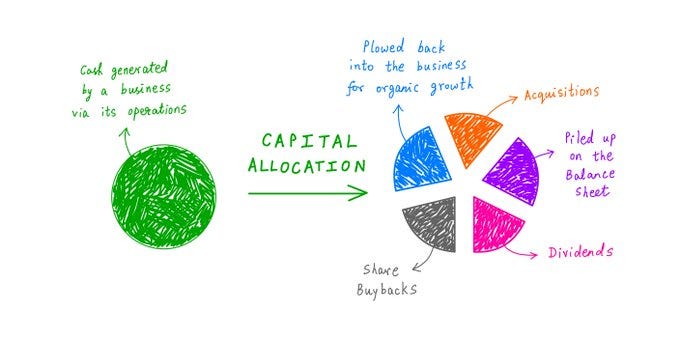
Capital allocation is what follows after a company generates cash. It’s a decision about what the company will do with the money it earns.
Management should put cash back to work at the most attractive rate of return. It’s their moral duty towards shareholders.
Track record management
It’s important to understand that most CEOs reached the top of their company because they were excellent in sales, marketing, R&D, etc.
This means that most CEOs have no practical capital allocation experience at all when they get promoted to the CEO role.
That’s remarkable, as capital allocation is BY FAR the most important task of management.

As an investor, it’s important to seek out companies that clearly define how they allocate capital.
Here’s a great example of Visa that shows you how it should be done:

You want to invest solely in companies where management has a great capital allocation track record.
If you select companies managed by great capital allocators, you’ll end up with very good investment results.
Capital Allocation Options
In general, a company has four capital allocation options:
Organic growth
Strengthen the balance sheet
M&A
Return capital to shareholders (dividends and/or share buybacks)
1. Organic Growth
Organic growth is the most preferred capital allocation choice.
You want to invest in companies that can reinvest a lot of their earnings into future growth opportunities at attractive rates of return.
It’s essential that the company has a high and stable ROIC when it reinvests a lot in organic growth.
Why? Because something magical happens when a company has a high ROIC in combination with plenty of reinvestment opportunities.
Let’s look at an example:
Not So Quality Inc.
Invested capital in year 0 = $100 million
ROIC = 5%
Reinvests all its earnings to grow organically
Quality Inc.
Invested capital in year 0 = $20 million
ROIC = 25%
Reinvests all its earnings to grow organically
When both companies reinvest all their earnings at a ROIC of 5% and 25%, respectively, the evolution of their net profit looks as follows:

As you can see, after 10 years, the net profit of Quality Inc. is 5.7 times as high as that of Not So Quality Inc.!
How did I calculate this?
Net profit = ROIC * Invested Capital
Year 0:
Net profit Not So Quality Inc. in year 0 = 5%*$100 million = $5 million
Net profit Quality Inc. in year 0 = 25%*$20 million = $5 million
In year 1, invested capital increases with the net profit of year 0, as both companies reinvest all their earnings in organic growth.
Year 1:
Net profit Not So Quality Inc. in year 1 = 5%* $105 million = $5,25 million
Net profit Quality Inc. in year 1 = 25%*$25 million = $6,25 million
The example above beautifully shows you why a company with a high ROIC active in an industry with a clear secular trend creates a compounding machine.
Great examples of secular trends are cybersecurity, urbanisation, electronic payments, and obesity.
2. Strengthen The Balance Sheet
A company can also use the cash it generates to pay down its debt.
This is especially an attractive option when the company is in bad financial shape.
A healthy balance sheet gives companies flexibility.
Just take Microsoft for example, where Bill Gates insisted that Microsoft should always keep enough cash in its bank account to keep the company alive for 12 months when it would generate no revenue at all.
3. Mergers and Acquisitions
Research has proven that 60–90% (!) of all acquisitions destroy value.
That’s why you should always be cautious when a company announces a big acquisition.
In general, it’s very hard to predict which M&A activities will create value and which won’t.
Managers can also have their personal agendas as acquisitions result in more revenue and more employees. This usually translates into a higher salary and more prestige for the CEO.
In general, I am not very enthusiastic about acquisitions for the reasons mentioned above.
For me personally, large M&A activities only make sense when 2 criteria are met:
Management has skin in the game.
When the acquisition destroys value, this also has negative implications for management.
The company has proven to be a successful serial acquirer in the past.
These kinds of companies often have a unique culture, Examples of great serial acquirers are Danaher, Constellation Software and Lifco.
4. Return Capital To Shareholders
Last but not least, a company can also return capital to shareholders via dividends and/or share buybacks.
A company usually returns capital to shareholders when it doesn’t have any other attractive growth opportunities.
When a company pays out a dividend, always look at the dividend yield and the payout ratio of the company. Dividend aristocrats are stocks that have increased their dividend every year for at least 25 years.
Regarding share buybacks, it’s important to underline that share buybacks only create value when the stock is undervalued.
This is very logical, as buying back your own shares can be seen as an investment in your own company. As an investor, you also only want to buy stocks when they are undervalued.
You aren’t convinced yet? Let’s give an example.
Let’s say Company A and Company B both have 1 million shares outstanding and you own 1% of both.
Company A:
Stock price: $10
P/E: 5x
Company A will buy back shares for $3 million
Company B:
Stock price: $50
P/E: 25x
Company B will buy back shares for $3 million
When Company A buys back shares for $3 million, it can buy back 300,000 shares. As a result, the number of outstanding shares decreases to 700,000 and your stake increases from 1% to 1.42%.
When Company B buys back shares for $3 million, it can only buy back 60,000 shares. As a result, the number of outstanding shares decreases to 940,000 and your stake increases from 1% to 1.06%.
The example above shows that the cheaper the stock, the more value share buybacks create for you as a shareholder.
Conclusion
That’s it for today.
You want to learn more?
William Thorndike’s excellent book, The Outsiders, is a must-read. His book gives examples of 8 CEOs who managed to outperform the S&P 500 by a wide margin thanks to their excellent capital allocation skills.
Furthermore, Michael Mauboussin’s paper is a must-read too:

About The Author
Hey, I'm John, a self-confessed finance enthusiast with a clear goal. My life revolves around numbers, market trends, and economic theories. This website is where I break down intricate financial ideas, explore investment strategies, and share my passion for all things finance. Join me on this journey to unravel the intricacies of the financial world.
Fantastic coverage as always. Thanks for all the knowledge you share.
Your newsletter is the most educational and well written newsletter on investing that I have seen.